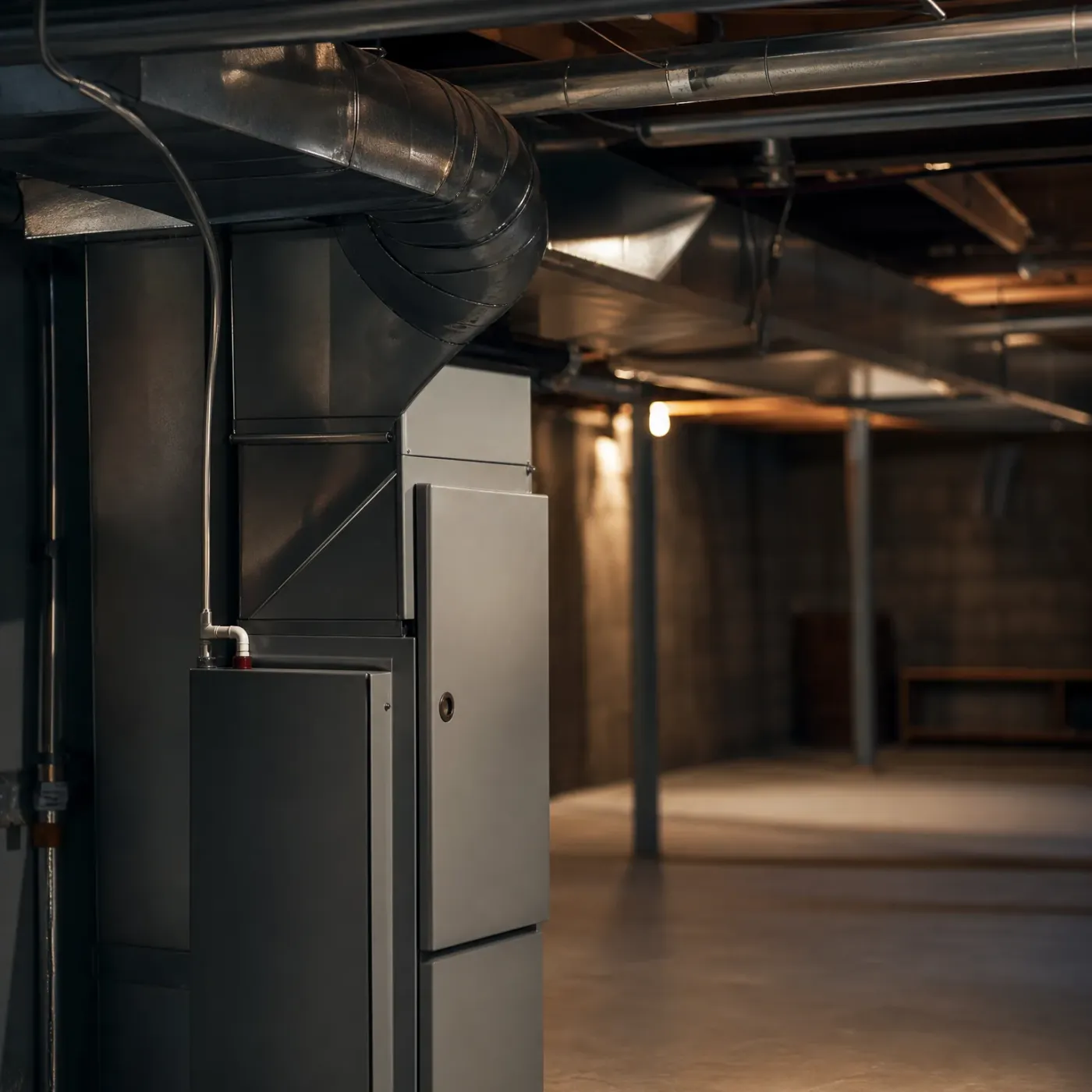
A basement interior with a gray furnace or air handler unit connected to large sheet-metal ductwork running along the exposed joist ceiling, with support posts and a concrete block wall in the dim background.

Get matched with a duct system pro in Jefferson County

Signs of leaky ductwork in Louisville, KY

Ductwork that leaks shows up as rooms that never get comfortable, a utility bill that climbs past what your gas and electric use should cost, or dust that keeps settling no matter how often you clean. This page walks through what to look for and feel for at your vents and in your attic or crawlspace. Once you know what you're seeing, you can get matched with a contractor who can take it from there.

Get my match

A leaky duct shows itself room by room. One bedroom stays warm in January while the rest of the house is fine. The upstairs never cools off in August even though the thermostat says it should. These point to a duct run that's losing air into the attic or crawlspace before it reaches the vent. You might also feel it directly: hold your hand near a duct joint in the attic or basement and feel air moving where there's no vent at all. Check your supply vents too. A vent with weak, barely-there airflow compared to the others often sits at the end of a run that's been bleeding air the whole way there. Your gas and electric bill is another clue. If it's climbing past what your usage should cost, the furnace or AC may be running longer to make up for air that never makes it inside. Dust building up fast on surfaces you just cleaned can mean the return side is pulling in attic or crawlspace air along with the dust in it.

Galvanized sheet-metal ductwork and round pipes run along a wooden floor joist ceiling above a bare concrete wall and floor.
Before you get your ductwork cleaning
Unfinished basement with concrete floor and walls, exposed wood joists, steel support posts, and large galvanized sheet-metal ductwork running to a furnace or air handler against the far wall.
After you get your ductwork cleaning

Where a leak sits in the system changes what you notice. One near the furnace or air handler touches every room on that line, so comfort problems show up everywhere at once. A leak further out, on a branch feeding one bedroom or the bonus room over the garage, only shows up there. The supply side and return side act differently too. A supply leak loses air before it reaches the room, so the system runs longer trying to make up what never arrived. A return leak works the other way. It pulls air from wherever the duct runs, often a dusty attic or crawlspace, straight into what gets heated or cooled and blown through the house. That's why dust that comes back fast after cleaning usually points to a return leak rather than a dirty filter. Check the joints themselves if you can get to them. Real duct seams are closed with mastic or foil tape. Cloth-backed duct tape, the kind sold for everything else, dries out and lets go within a few years. Flex duct connects to metal collars with a clamp, and a clamp that's slipped loses air right there even when the duct itself is sound.

How a leak actually behaves

  • A duct joint seals with mastic or foil tape, not the cloth-backed tape most people call duct tape, which dries out and lets go within a few years.
  • Return ducts that pull air from a dusty crawlspace or attic draw that air into the house, so dust showing up fast after cleaning points to a return leak rather than a dirty filter.
  • A supply run that leaks dumps conditioned air into the attic or crawlspace before it reaches the room, so the furnace or AC runs longer to make up for air that never arrives.
  • Flex duct connects to metal collars with a clamp, and a clamp that's loosened or slipped lets air escape at the connection even when the duct itself is fine.
  • Leaks on the return side pull outside air through the attic or crawlspace, so humid air in August or cold air in January gets drawn straight into the airflow.
  • A leak near the furnace or air handler affects every room downstream of it, while a leak further down a branch line usually shows up in just one or two rooms.
An older man with gray hair and a beard, wearing a dark jacket dusted with snow, stands smiling in a dimly lit hallway with lamps and a living room visible behind him.
A gray-haired, bearded man in a dark snow-dusted coat stands smiling in a dimly lit entry hall with a staircase, a lit table lamp, a framed picture, and a living room visible through a doorway.
An older man with white hair and a beard, wearing a dark snow-dusted coat and scarf, stands in a warmly lit interior hallway with a framed landscape picture, a table lamp and a potted plant behind him, and a snowy view through a window at left.
A gray-haired, bearded man in a dark coat dusted with snow stands smiling in a dimly lit room with a lamp, mirror, framed art, and a sofa in the background.

Why does duct leakage matter so much for your house, specifically?

  • Half the homes here were built by 1972

    Half the homes in Jefferson County were built in 1972 or earlier, and ductwork that old has had decades for joints and seams to work loose.

  • Heat runs October through April

    Heat runs here from October through April, so a leaky return pulling attic or crawlspace air feeds dust and cold air into your system for seven months straight.

  • Cooling runs May through September

    Cooling runs May through September, and a duct leak during those months means you're paying to cool air that never makes it past the attic.

ACS 2020-2024 · NOAA nClimDiv 1991-2020

Unfinished basement with bare concrete floor and walls, exposed wood joists, metal ductwork, a furnace unit, steel support posts, and a small window.

Ducts sealed and sound

Air leaves the furnace through the metal trunk and gets to every room through the ducts branching off it. When the joints are tight, the register in the basement and the one upstairs both get the air the system paid to heat or cool.

Empty basement with bare concrete walls and floor beneath an exposed wood-joist ceiling carrying galvanized sheet-metal ductwork, round ducts and pipes.

Ducts losing air along the way

That spiral duct and the metal runs beside it only cool or heat the house if the air stays inside them. A seam that's worked loose dumps conditioned air into the joists and the space above the concrete floor instead of the rooms you're paying to heat.

Where in the House Is It Leaking

Attic and crawlspace ducts

  • Flex duct running through an unconditioned attic can pull loose at a connection and dump heated or cooled air into that space instead of the room it's meant for.
  • A crawlspace duct run sits close to the ground, and if it separates at a joint, it can draw in the damp, musty air from under the house.
  • You can sometimes feel warm or cool air moving in the attic near a duct run on a day when the system is working hard.
  • Insulation around a duct in the attic that looks matted down or dirty in one spot often marks a leak that's been there for a while.
  • These runs are harder to see and harder to reach, so a leak here can go unnoticed longer than one inside a wall or closet.

Ducts inside the house

  • A duct run behind a closet wall or under a floor leaks into a space you already walk through, so warm or cool air escaping there sometimes changes how that room feels.
  • A disconnected duct under a floor can send air into the crawlspace below instead of up through the register.
  • You can check a joint you can reach, like one behind an access panel, by holding your hand near it while the system runs.
  • A gap at a boot where the duct meets the register sometimes shows up as a draft right at the floor or wall vent.
  • Because these runs sit inside the conditioned part of the house, a leak here can still warm or cool the room some, even while it wastes air meant for somewhere else.
A dimly lit living room corner with a gray wall, framed picture, a table lamp on a wooden side table, a beige sofa with pillows, a ceiling vent, and windows showing flowering trees outside.

The vent grille in the ceiling is going gray at the edges, a soft ring of dust spreading out onto the carpet below it. It's a mild spring afternoon, the kind where the furnace barely runs, and you're on the couch with the window cracked when you notice it. You run a finger along the grille slats and it comes back dark. The end table under it has the same film, even though you wiped it down a few days ago. Nobody tracked anything in. The air coming through that vent has been carrying more than warm air all winter, and now that the house is finally still, you can see where it landed.

A pro who works on ducts

After you send the request, you're done searching.

It costs nothing to send, and you don't have to hire anyone.

Why pressure gives the leak away

A furnace or AC pushes air down the trunk line under pressure, and that pressure is what forces air out through any gap in a joint or seam. The supply side runs under more pressure than the return side, which is why supply leaks lose more air and show up faster as a room that won't heat or cool. A duct system that's sealed tight holds that pressure all the way to the register. One that isn't loses a share of it into the attic, the crawlspace, or the wall cavity before the air ever reaches the room, and the system has no way to make up for air it never delivered.

What a pressure test finds

A contractor can check for duct leakage directly with a duct blaster test, which pressurizes the duct system and measures how much air it takes to hold that pressure. Air that has to be added steadily to hold the number is air leaving through a gap somewhere in the run. This gives an actual reading instead of a guess, and it's the only way to know whether a run losing comfort is leaking ten percent of its air or fifty. It also shows which runs are the problem, since a whole-house system can have one bad duct in the basement and a dozen sound ones everywhere else.

Power here costs 12.34 cents per kilowatt-hour

At 12.34 cents per kilowatt-hour, the electric half of your bill runs cheap, which is exactly why a spike feels so out of place. If a leaky return is pulling attic or crawlspace air into the system, the blower runs longer to make up for it, and that shows up on the bill even at this rate.

EIA-861 2025

Galvanized sheet metal HVAC ductwork and round pipes running along an exposed wood-joist basement ceiling beside a plain white wall.

A duct leak you can smell

A return duct running through a crawlspace or attic will pull whatever is in that space into the air the furnace handles next. If the crawlspace has been damp, you'll catch a musty smell when the system kicks on. If the attic gets hot in August, the air coming through the vents can carry a stale, baked smell with it. Either one points to a return that isn't sealed where it should be.

Galvanized sheet metal HVAC ducts and round pipes installed among wooden joists on a ceiling, beside a large blank white wall.

A duct leak you only hear

Stand near a supply vent while the furnace or AC is running and listen for a faint hiss or whistle. That sound is air forcing its way out through a gap in a joint before it ever reaches the room. It's easy to miss over the blower noise, so check a few vents across the house rather than just one, since the leak may only be on one branch of the line.

Can a leaky duct make a room colder than the rest of the house?

You've noticed one room, maybe a bedroom at the end of the hall, that's always a few degrees off from the rest of the house. The thermostat says the system is doing its job, and every other room seems fine, but that one room stays stubbornly cold in January or warm in August. It's the kind of thing that makes you wonder if something's wrong with just that room, or something further back in the system.

Yes, and it's usually the duct feeding that room, not the room itself

A single cold room almost always traces back to the duct run that feeds it. If that run has a loose joint in the attic or crawlspace, some of the air meant for that register is leaking out along the way, so what reaches the room is less than what the furnace sent. Every other room on that trunk line can be fine because their ducts are still sealed. The giveaway is that closing or opening vents elsewhere doesn't fix it, and the room doesn't improve no matter how long the system runs. A contractor can check static pressure at that specific run and find the leak rather than guessing room by room.

  1. Air leaves the furnace or air handler through the main trunk line.

  2. Pressure pushes air down branch ducts toward each room's register.

  3. A loose joint or seam lets conditioned air escape before it arrives.

  4. Lost air pulls in attic or crawlspace air through the same gap.

A man with a duffel bag walks up a concrete path toward a white board-and-batten house where a woman stands in the open wooden front door, flanked by potted plants and black lanterns.

What a leaky duct comes down to

A room that won't hold its temperature, a bill that's higher than it should be, dust that keeps coming back. Those are the signs, and each one points to the same thing: air leaving the duct before it reaches the register. Some of that you can check yourself, a hand near a joint, a look in the attic or crawlspace. Some of it you can only hear about secondhand, in what the bill or the thermostat tells you.

Once you know what to look for, the next question is what to do about it. A contractor who works on ductwork in Jefferson County homes can trace a leak back to the joint or seam causing it and tell you what the system actually needs. Answer a few questions about your house and someone who handles this work will be in touch, and from there it's off your plate.

A light gray sofa with gray and beige textured throw pillows and a cream knit blanket beside a white-framed window, with a small round side table holding a ceramic vase and potted greenery.
A woman wrapped in a thick cream knit blanket sits in a chair with an open book on her lap, beside a lit table lamp and a frost-covered window at night.
A smiling older woman with gray hair in a loose bun wearing a ribbed beige sweater stands in a dimly lit kitchen beside a window showing darkness outside, with a loaf of crusty bread on a wooden board in the foreground.

Ductwork Cleaning

Get your ductwork to the right pro

Send the form and the duct cleaning stops sitting on your list.

A smartphone with a blank green screen stands upright against a plain light gray background.
Duct and vent cleaningDucts or ventsJefferson County, KY
Step 1 of 2

What ZIP code is the job in?