

How long an AC takes to cool a house in Kentucky
A properly working AC in Kentucky usually brings a house down to a comfortable temperature in about two to three hours, once it's running steadily on a hot, sticky afternoon. The exact time depends on how hot and humid it is outside, how big your house is, and how well your system is holding up. Kentucky summers put a real strain on these units because the air conditioner isn't just cooling the air, it's also pulling moisture out of it, and that takes extra work on muggy days. If your AC is taking much longer than a few hours, or it runs most of the day without the house feeling any cooler, something is usually off: low refrigerant, a dirty coil, or a system that's struggling to keep up. A unit that's kept up through regular maintenance tends to cool faster and more evenly than one that isn't, since clean coils and proper airflow let it do its job without extra strain.

Why humidity slows the cool-down
Kentucky summers run thick with moisture, and your AC has to pull that moisture out of the air before the house feels cool. The system spends part of every cycle wringing water out through the coil, not just dropping temperature. That's why a muggy 90 degree day takes longer to cool than a dry one at the same reading. A thermostat that shows 74 but still feels damp usually means the coil hasn't caught up yet.

What a dirty coil or filter adds
A coil caked with dust or a filter clogged with a season's worth of pet hair cuts down the airflow moving across it. Less airflow means less heat pulled out of the house per hour, so a two hour cool-down can stretch toward three or four even though the compressor is running the whole time. A technician checking the coil and swapping the filter during a maintenance visit is often the difference between a system that keeps pace and one that falls behind on the hottest afternoons.
Cooling Fine or Falling Behind
Normal cool-down
- The house drops a degree or two every ten to fifteen minutes once the system has been running steady for a while.
- Air coming out of the vents feels noticeably cold the whole time, not just at the start of the cycle.
- Rooms farther from the thermostat lag behind but still catch up within that same two to three hour stretch.
- The outdoor unit runs long cycles on a hot afternoon and that's expected, not a sign of trouble.
- Humidity drops along with temperature, so the air feels lighter well before the thermostat hits its number.
Something's working against it
- Three or more hours pass and the house still feels muggy and only a little cooler than when you started.
- Vents blow air that's cool but not cold, which points to low refrigerant or a coil that needs cleaning.
- The outdoor unit shuts off and restarts every few minutes instead of running one long cycle.
- One part of the house cools fine while another stays warm no matter how long the system runs.
- The system seems to work but your electric bill climbs well past what a normal hot month runs.




Why does it feel like your AC can't keep up this summer?
You notice it most in the evening, after the sun has had all day to heat the house up. The system runs, but the living room stays warm an hour past when it usually would've caught up. Maybe the air from the vents feels cool but not cold, or one room upstairs never quite gets there while the rest of the house does fine. A weak capacitor, a dirty coil or a low refrigerant charge can all make a system run longer than it should to do the same job. Left alone, that strain tends to get worse, and a unit that's working harder than it needs to is more likely to fail on the next hot stretch, usually when you need it most.
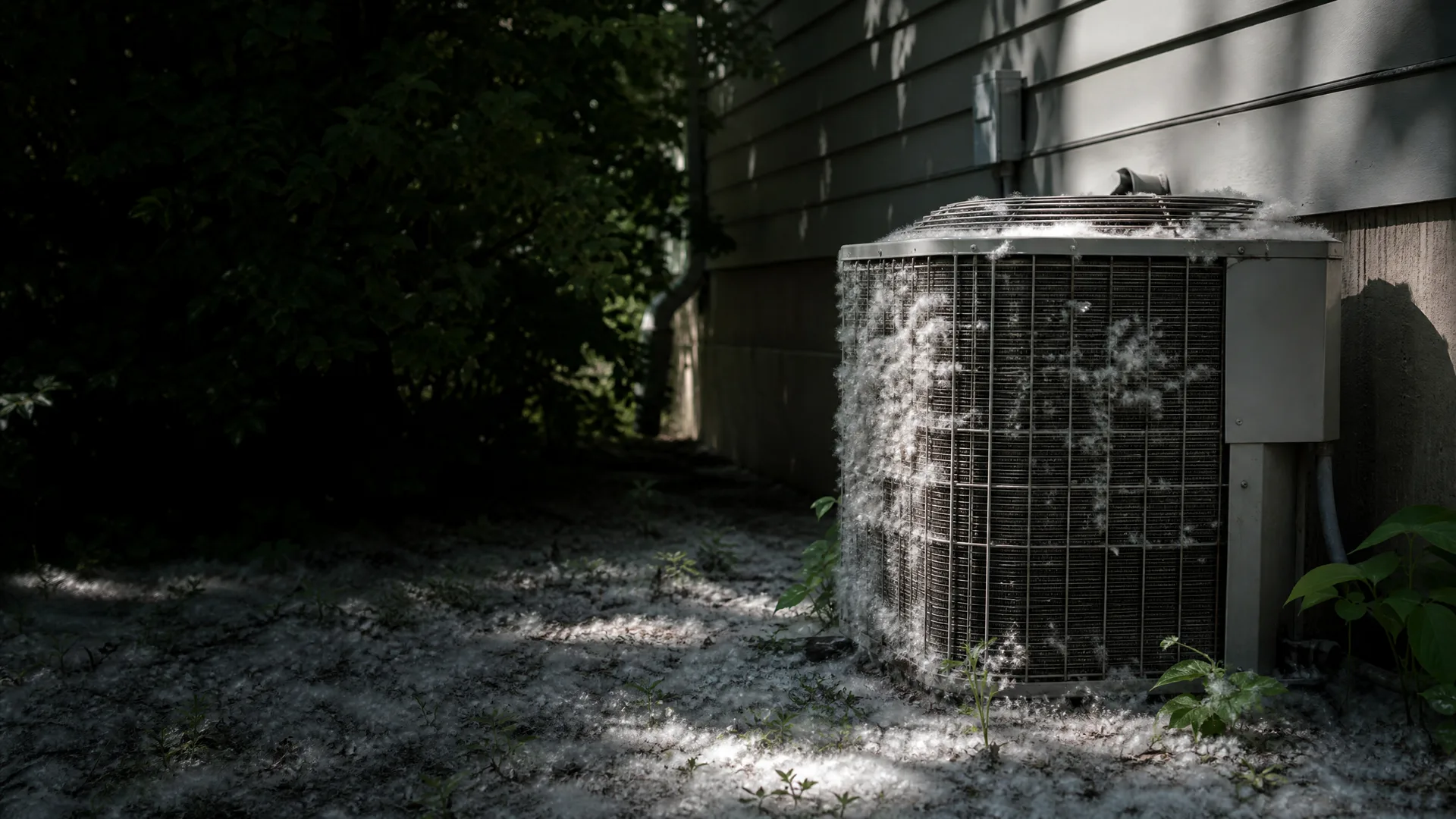
You're out by the side yard in late May, grass still wet from morning, and you walk past the condenser on your way to the garden hose. That's when you see it: the fins are packed white with cottonwood fluff, thick as a layer of snow across the whole unit. You crouch down and the fan behind it sounds like it's working harder than it should. You think about how long it's probably been sitting like that, blocking the airflow it needs to dump heat outside. You make a mental note to clean it off before the weekend, and head on toward the hose, the fluff still drifting down from the tree past the fence.
Skip calling around

A licensed local pro takes the request for your air conditioner tune-up.
There's no charge for the request.
How your AC actually cools the house
- The thermostat calls for cool, and the outdoor unit and indoor blower start at the same moment, not one after the other.
- Refrigerant moves from the outdoor coil to the indoor coil, where it absorbs heat from the air passing over it.
- The blower pulls warm house air across that indoor coil and pushes it back out through the ducts, over and over, each pass a few degrees cooler.
- A short cycle on a mild day only runs long enough to pull moisture off the coil, not long enough to drop the temperature much.
- The system doesn't cool the house in one pass; it takes dozens of passes through the same air before the thermostat reads satisfied.
- A dirty coil or a low refrigerant charge makes every one of those passes do less work, so the same cool-down stretches out longer.
The thermostat doesn't cool anything by itself. It just closes a switch that tells the outdoor unit and the indoor blower to start together. Refrigerant carries heat from inside your house to the coil outside, and that happens on a loop, one pass after another, the whole time the system runs. Inside, the blower pulls warm air from the rooms across the indoor coil, where the refrigerant takes the heat out of it, then pushes that air back through the ducts. That air comes back warm again a few minutes later, picks up from the same room, and goes through the coil again. Each pass only drops the temperature a little. On a mild day, the system might shut off after one of those short runs, long enough to pull some moisture off the coil, not long enough to make much of a dent in the air temperature. That's normal and doesn't mean anything's wrong. On a hot, muggy Kentucky afternoon, it takes dozens of these passes before the thermostat reads satisfied and shuts the system off. If the coil is coated in dust or the refrigerant charge has dropped low, every single pass moves less heat than it should. The system doesn't fail outright. It just keeps running, pass after pass, while the house takes longer to catch up than it used to.
Power costs 13.13 cents per kilowatt-hour statewide
At 13.13 cents per kilowatt-hour, running your AC through a two or three hour cool-down doesn't sting the way it might elsewhere. That's part of why most Kentucky homes lean on electric heat too. Keeping the system maintained is what keeps that cool-down time from creeping longer and taking more power to get there.
EIA-861 2025 statewide residential average
A maintained system on a hot day
A unit that's had its coil cleaned and its charge checked this year will still take a couple hours to pull a Kentucky house down on a 90 degree afternoon. That's normal. What you notice is the steady progress. The air at the vents stays cold, the outdoor fan runs smooth, and the house drops a degree every ten or fifteen minutes like it should. Nothing about the sound or the airflow changes partway through the cycle. A contractor who services this equipment every summer can tell you in a few minutes whether yours is working the way it's supposed to, and catch a dirty coil or a low charge before it turns into a longer wait.
A neglected system on the same day
Put a unit with a clogged coil or a weak capacitor in that same house on that same afternoon, and two hours stretches toward four, or the house never quite gets there before the sun goes down again. The compressor runs longer to do less work. Rooms upstairs lag further behind than they should. You end up running the thermostat lower just to get relief in the room you're sitting in, and the system still can't close the gap. None of that shows up as a breakdown. It shows up as a slow afternoon that repeats every time it's hot, which is most of a Kentucky summer.



A summer dew point averaging 65°F across June, July and August, per NOAA climate data, is why the air in Kentucky feels heavy even when the temperature itself isn't that high. Your AC has to pull that moisture out before the house feels cool, which is a slower job than just dropping the thermometer reading. On a muggy evening you'll notice the system running longer than the temperature alone seems to call for, and the air at the vents may feel cool but not dry. A coil that's clean and a charge that's correct matter more here than in a drier climate, since a system working harder to wring out moisture leans on both.
NASA POWER T2MDEW county cells weighted by homes

Two to three hours, if the system's been kept up
A Kentucky house cools down in two to three hours when the system behind it is running the way it should. That number holds on a sticky July afternoon as well as a milder one in May, as long as the coil is clean, the charge is right, and the blower is moving the air it's supposed to move. When one of those slips, the time stretches and the house never quite catches up.
Finding out which one slipped on your system means getting someone out to look at it, and that's usually where the afternoon goes sideways. You end up searching for a contractor, calling a few, explaining the same slow cool-down and warm upstairs rooms to each one, then sitting with three quotes trying to guess who's actually right about what it needs. A technician who services AC systems in your part of Kentucky all summer has likely already seen what's slowing yours down, and you only have to explain it once.


Describe it once
Only one pro gets your request, so you hear from one company.
You only hire the pro if you want to.