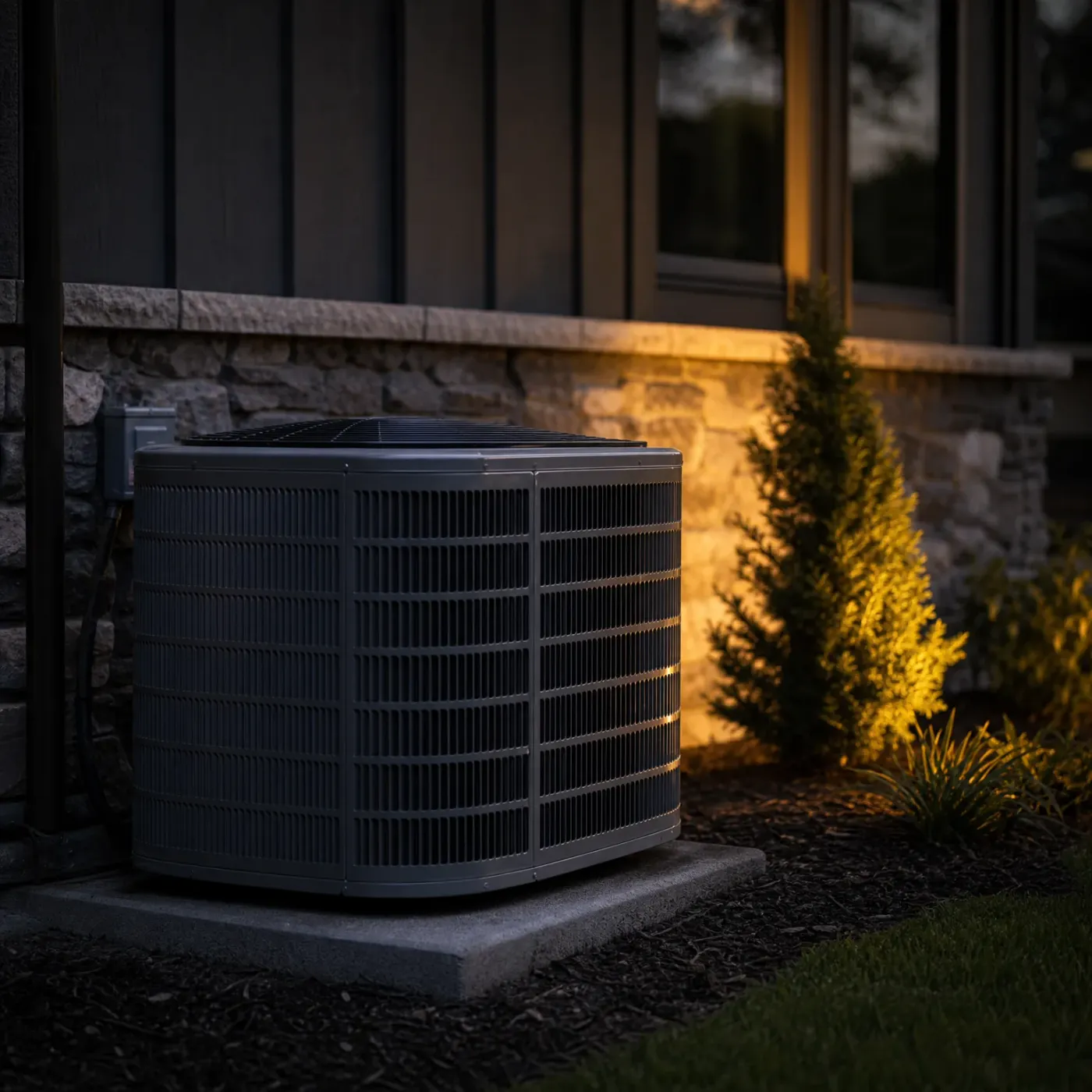





An outdoor air conditioning condenser unit on a concrete pad beside a house with stone veneer and vertical board siding, with a small shrub and mulch bed lit by a ground light at dusk.

No phone calls to make

Why your AC is blowing dust in Kentucky

Dust coming out of your vents usually points to a dirty filter, leaky ductwork, or a coil that needs attention, and which one it is changes what gets fixed. This page walks through why it happens and what to check first. Skip the round of calls to different companies and the back and forth explaining the same problem twice. One local contractor who services AC systems all summer can take a look and tell you what's going on.

Skip the calls

Dust blowing out of your vents usually means air is bypassing your filter somewhere, or your ducts are pulling dust in from a place they shouldn't. A filter that's clogged or sized wrong lets air slip around its edges instead of through it, so whatever it's supposed to catch ends up back in your rooms. Gaps or loose connections in the ductwork do something similar, pulling in dust from your attic or crawlspace every time the system runs. Humid Kentucky summers make this worse, because dust mixes with the moisture your AC is pulling out of the air and settles into the coil and the ducts instead of draining away clean. If this has been going on for a while, it's worth finding out which of these it is, because a dirty coil cuts into how well your system cools, and a duct leak means you're paying to condition air that never makes it into your house.

An outdoor air conditioning condenser unit on a concrete pad beside a house with white horizontal lap siding, with an electrical disconnect box and insulated refrigerant line on the wall and a shrub over mulch to the right.
A clean filter seated tight, ductwork sealed, coil clear of buildup, no dust riding the air coming out of your vents.
An outdoor air conditioner condenser unit on a concrete pad beside a house with light horizontal lap siding, with an electrical disconnect box and conduit on the wall behind it.
A gap around an old filter, a joint in the ductwork pulling in attic air, a coil caked with dust nobody's checked in years.
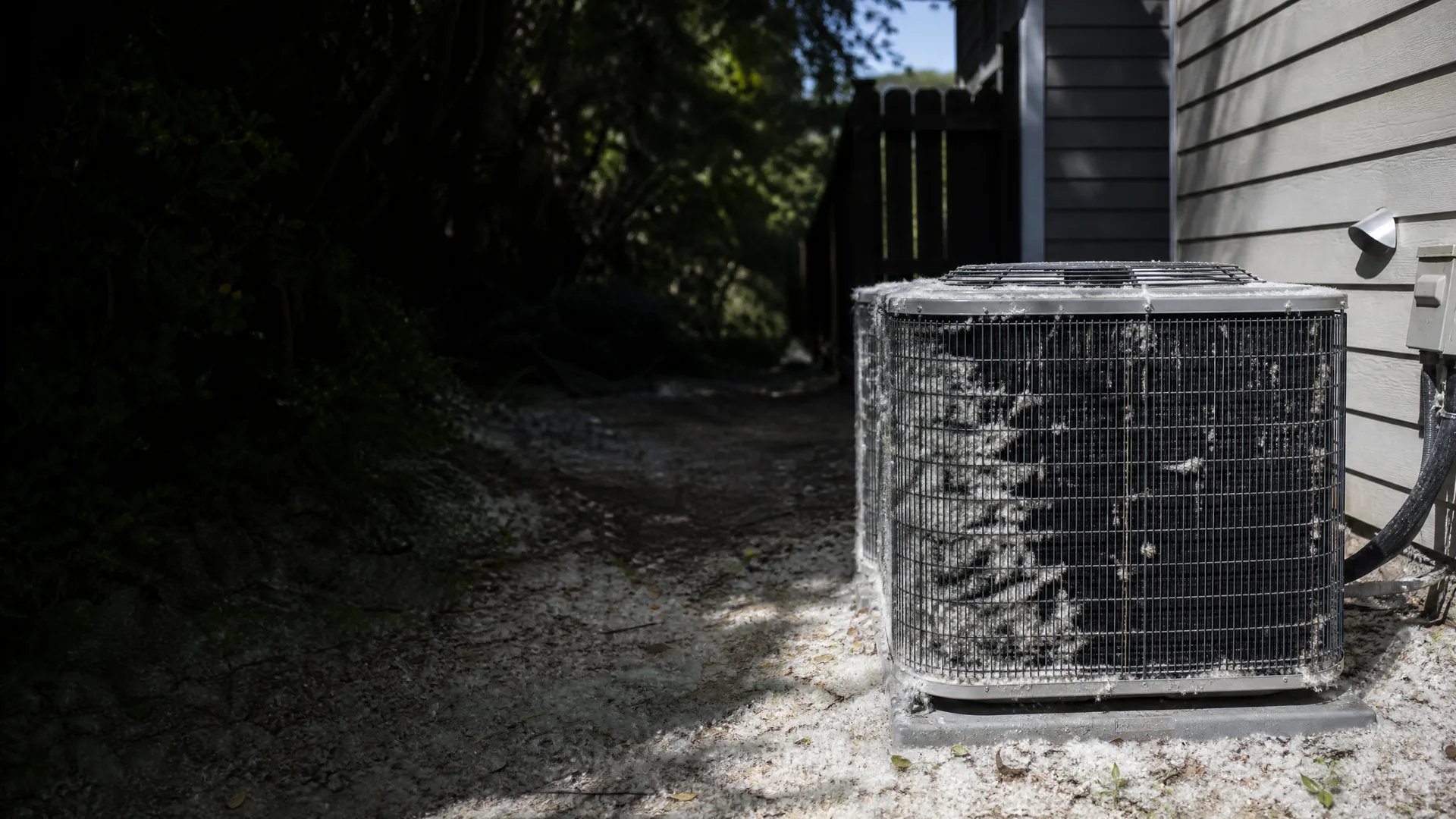
An outdoor air conditioner condenser unit covered in white foam-like debris sits on a concrete pad beside a light-colored lap-sided house, with white flecks scattered on the ground and dark trees and a wooden fence behind.

You're out checking the condenser on a Saturday in late May, the kind of day that's already sticky by ten in the morning. The side yard smells like cut grass. That's when you see it: the fins are matted white, almost furry, like someone wrapped the unit in cotton. Cottonwood fluff, blown off a tree down the block, caught on the coil and packed itself in between the fins. You run a finger across it and it's dense, almost felted. The unit's running, you can hear it, but the airflow through that coil has to push through all that fluff first.

A closed dark laptop and a ceramic mug of coffee on a wooden dining table, with wooden chairs, a dark kitchen cabinet with cutting boards and a potted plant, and a leafy plant by a window in the background.

What's actually moving that dust through your ducts

Your air handler doesn't just cool air, it moves a few hundred cubic feet of it every minute, pulling return air through the filter and pushing it out through the supply ducts to every room. That filter is the only thing standing between the air in your house and the blower wheel and coil behind it. If air finds a way around the filter instead of through it, whatever it's carrying rides along for the trip. A duct joint that's come loose in the attic, a return box that was never sealed right, a filter slot that's a quarter inch too big for the filter in it. Small gaps, steady leak.

A technician who services AC systems in Kentucky all summer knows where these gaps tend to show up, because the ductwork and attic setups around here tend to repeat from house to house. Finding that out yourself means pulling panels, checking the filter fit, maybe climbing into the attic to look at duct joints you've never seen before. A maintenance visit puts someone in your attic who's done this before, checking the filter fit, the duct seals, and the coil in the order that actually finds the leak, instead of you guessing room by room which vent is worst.

A living room corner with a beige sofa and cushion, a round wooden coffee table holding a pale ceramic vase of eucalyptus stems and a wooden bowl, and a curtained window with a potted plant above a latticed radiator cover in the background.
A gray outdoor air conditioner condenser unit on a concrete pad beside a house with white horizontal siding and a brick foundation, with a wall-mounted disconnect box and conduit, and a green shrub with mulch at left.

Running clean

The grille and coil behind it stay clear, so the fan pulls air straight through the filter the way it's supposed to. Nothing on the outside tells you anything's wrong, which is the point. A unit that looks like this isn't adding dust to what's already moving through your ducts.


An outdoor air conditioning condenser unit on a concrete pad beside a house with white horizontal vinyl siding, with a gray electrical disconnect box and refrigerant lines on the wall behind it.

Caked and clogged

That grime on the grille is the same stuff drifting through your vents, just caught on the way in instead of blowing out. A coil this dirty makes the system work harder to pull air through, and whatever gets past it ends up in the rooms you're sitting in.

A woman in a cream sweater with her hair in a bun laughs while seated at a stone counter holding a glass of red wine, in a dimly lit interior with a sofa, houseplants and a large window at night.
A woman with long dark hair in a cream knit sweater laughs while looking off to the side, seated in front of a dimly lit kitchen with an island, stools, open shelving and a potted plant, with a glass of red wine in the foreground.
A smiling woman with long dark wavy hair in a light knit sweater sits at a marble counter with a glass of red wine, with a dimly lit living room and kitchen in the background.
A smiling woman with long wavy brown hair in a beige sweater sits at a white marble counter with a glass of red wine, with a living room, dining table and kitchen cabinets behind her.

One form, no calling around

Your request goes to one pro, not a list of companies.

You only hire the pro if you want to.

Why a leaky duct pulls in more

Your return side runs at a slight negative pressure whenever the blower is on, which is what pulls air through the filter in the first place. If there's a gap in that same return duct, especially one running through the attic or a crawlspace, it pulls air from there too, dust and all. That air never passes through the filter. It joins the stream after the fact and rides straight out your supply vents. A duct that's sealed everywhere along the return side doesn't have this problem, no matter how clogged the filter gets.

What a dirty coil adds to the air

The evaporator coil sits right in the path of every cubic foot of air your system moves, and it's wet most of the time it's running, since that's how it pulls moisture out of the air in a Kentucky summer. Wet surfaces catch dust instead of letting it pass. Once enough builds up, some of it dries and flakes off into the airstream instead of staying put. A coil that's been cleaned recently doesn't shed anything. One that hasn't been looked at in a few summers usually has a layer built up on the fins already.

An outdoor air conditioning condenser unit on a concrete pad beside a house with horizontal lap siding, with an electrical disconnect box and conduit on the wall, mulch and a green shrub to the right, and a concrete walkway in the foreground.
Before you get your air conditioner maintenance
A gray outdoor air conditioner condenser unit on a concrete pad beside a house with horizontal siding and a stucco foundation, with a disconnect box and conduit on the wall, decorative gravel, mulch, and a shrub nearby.
After you get your air conditioner maintenance
  1. Return air gets pulled through the filter before it reaches the blower.

  2. A worn filter or gap around its frame lets air slip past unfiltered.

  3. The blower pushes that air through the supply ducts to every room.

  4. A loose duct joint, especially in the attic, pulls in extra dust along the way.

Power costs 13.13 cents per kilowatt-hour statewide

At that rate, running your blower longer to fight dust doesn't hit your bill the way a second window AC or an electric furnace would. It's worth having a contractor check your filter fit, ducts and coil before you just crank the fan speed up to compensate.

EIA-861 2025 statewide residential average

A bearded man in a dark navy sweater over a collared shirt smiles and looks off to the side while seated at a dinner table with a glass of red wine, a lit candle, and a plate of food in the foreground of a dimly lit room.
A woman in a dark gray sweater reclines on a couch with her eyes closed and a knit blanket over her lap, an open book resting face-down in front of her, with a lit table lamp and shelving blurred in the background.

Where the dust actually stops

  • Dust in the air coming out of your vents traces back to a filter not sealing, a duct leak, or a dirty coil, not the AC unit itself failing.
  • A filter that fits loose or a joint pulled apart in the attic lets unfiltered air into the system before it ever reaches a room.
  • A coil caked with buildup can shed into the airflow long after the filter and ducts check out fine.
  • Checking all three takes someone who already knows where Kentucky ductwork tends to separate and which coils run dirty by midsummer.
  • One licensed contractor local to you takes this on, so you're not fielding calls from four companies while you try to sort out who's right.
  • Once the actual source gets found and fixed, the dust stops; swapping filters more often or running the fan harder never addressed it.

The dust coming out of your vents has a source, and it's one of three things: a filter that isn't sealing against its frame, a duct joint that's pulled apart somewhere it shouldn't, or a coil that's built up enough buildup to shed into the airflow. None of those fix themselves, and none of them get fixed by a new filter alone if the real problem is a gap in the attic ductwork or a coil that's been collecting dust for a couple of summers.

Finding which one it is means someone has to look, and looking well means knowing where to look first. Ductwork in Kentucky attics tends to separate at the same joints, year after year, in homes built the same way. A coil that's run all summer without being checked is a known quantity to someone who's cleaned a hundred of them by July. That's the kind of thing you can't get from a filter swap or a fan speed adjustment, and it's why a contractor who already works on this equipment in your area gets to the answer faster than a guess.

A single licensed contractor local to you takes this on from start to finish. You're not explaining the same problem three times to three different companies, or trying to figure out whose estimate to trust. One person looks at your filter, your ducts, and your coil, and tells you which one is actually letting the dust through. Once that gets fixed, the dust stops, because the source is gone, not just covered over until the next filter change.

A single-story stucco house at dusk with a lit paver walkway lined by low path lights, desert plants and boulders in front, and distant mountains under an orange and blue sky.

Air Conditioner Maintenance

Skip the search

Tune-up, service, or cleaningCentral ACKentucky
Step 1 of 2

What ZIP code is the job in?

  • A dimly lit living room corner with a beige upholstered sofa holding a dark green cushion and a chunky knit throw, beside a wooden sideboard with a lit ceramic table lamp, a small potted plant, and a wooden bowl, with a framed artwork on the wall and a mug on a book in the foreground.
    • A local pro who services air conditioners gets in touch about the tune-up.
    • Describe your air conditioner job, and a local pro who handles it gets in touch.
  • A round wooden coffee table holding a round stone vase of green foliage, a lit candle in a glass container, and a small dark bowl, with a beige sofa, cushions and knit throw behind and a window at left.
    • After you send the request, you're done searching.
    • Send the form, and lining up the air conditioner tune-up stops being yours to chase.
  • Sunlit living room with a wooden coffee table holding a ceramic vase of leafy branches and a carved wooden tray with two stacked books, in front of a beige sofa with tan and green cushions and a potted plant near a window.
    • One form replaces the calls you'd make to find an air conditioner pro.
    • Skip calling around to set up an air conditioner tune-up.
  • Interior corner with a lit ceramic table lamp and wooden bowl on a wood sideboard, a framed picture and branch-filled vase behind, a knit throw over an upholstered chair, and a lit candle in a glass holder, stoneware mug and round planter of green foliage on a wooden table in the foreground.
    • Only one pro gets your request, so you hear from one company.
    • Your request stays with one local pro.