Mini Split Installation in Mount Washington, KY
A new system here will heat from October through April and cool from May through September every year. Tell us about the house, and a licensed contractor who covers Bullitt County will get in touch.
Tell us about the job
It takes about a minute.
Mount Washington asks a mini-split to run nearly all year
Nights here average 28°F in December, January, and February, and a mini-split has to hold heat against that from October through April, seven months straight. Summer swings the other way, with afternoons averaging 86°F from May through September. That is twelve months of the year where the system is either heating or cooling, with barely a break between seasons.
Any mini-split installed new has to meet the federal minimum for split-system heat pumps, 14.3 SEER2 for cooling and 7.5 HSPF2 for heating. Bullitt County also sees its share of winter storms and wind events that knock out power, and close to a quarter of Kentucky households lost power for a full day or more in 2024. When the power comes back, a mini-split heat pump starts up on its own, without anyone resetting it.
- 7 months
- October through April, your system heats
- 5 months
- May through September, it cools
- 28°F
- the average winter night it heats against
- 86°F
- the average summer afternoon it cools against
NOAA nClimDiv, 1991–2020 normals
Kentucky requires HVAC contractors to hold a state license.
Kentucky licenses HVAC contractors through the Department of Housing, Buildings and Construction. That license belongs to the contractor, not to any single job, so it covers the company doing the work rather than being issued fresh for your mini-split.
Most cities and counties in Kentucky require a permit for a mini-split installation and an inspection once the work is done. That check happens at the local building office and is separate from the state license.
Sources: Kentucky Legislative Research Commission · Kentucky Department of Housing, Buildings and Construction
- Is a mini split worth it?
- For most homes here, yes, because a mini split handles both jobs, heat from October through April and cooling from May through September. One system covers all 12 months instead of running a furnace and a separate AC. Winter nights average 28°F here, and a mini split heat pump is built to keep working at that kind of cold, so it is not just a summer machine in this climate.
- How many rooms can a mini split cover?
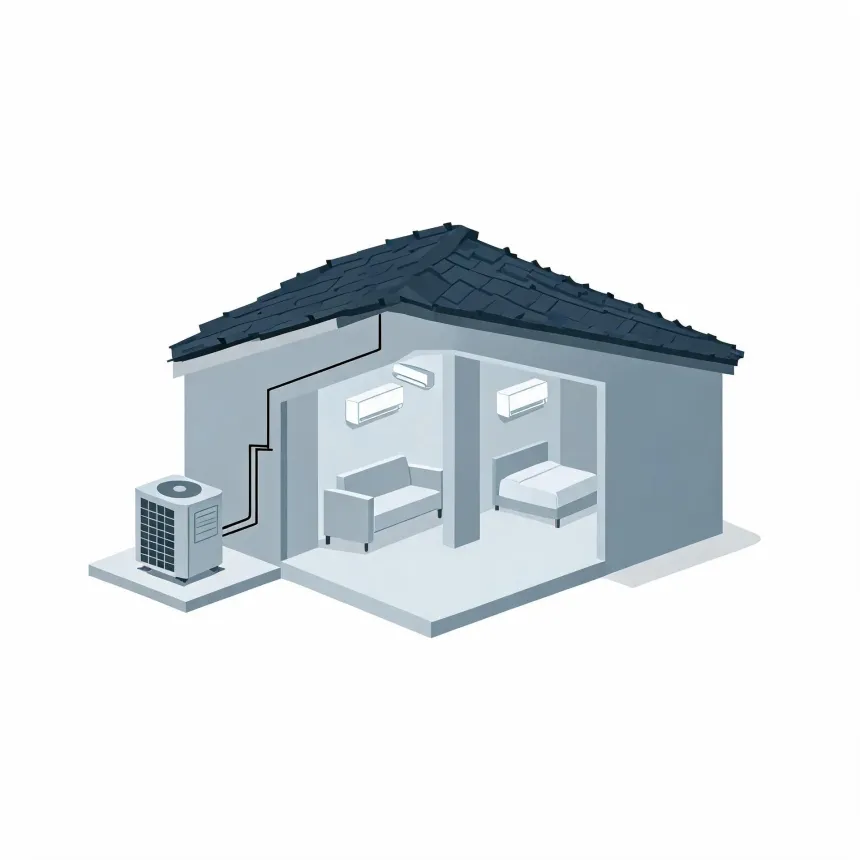
- A single outdoor unit can run one indoor head or several, depending on how it is set up. A single-zone system covers one room or open area well. A multi-zone system ties several indoor heads to one outdoor unit, so it can reach bedrooms, a living room and other separate spaces at the same time. How many zones make sense for a given house is something a contractor works out from the layout, not a fixed number.
- Can a mini split heat a whole house?
- It can, if enough indoor heads are placed to reach every room that needs heat. A single head warms the room it is in and maybe the space right around it, but it will not carry heat down a hallway into closed-off bedrooms on its own. Homes here need heat seven months of the year, October through April, with winter nights averaging 28°F, so whole-house coverage means sizing the system and placing heads for that real cold, not just for mild days.