Mini Split Installation in Louisville, KY
A new system here will heat from October through April and cool from May through September every year. Tell us about the house, and a licensed contractor who covers Jefferson County will get in touch.
Tell us about the job
It takes about a minute.
What a mini-split here has to handle
Jefferson County asks for heat or cooling every month of the year. Winter nights average 27°F from December through February. Summer afternoons run near 86°F from May through September. That's seven months of heating and five months of cooling on the same system, with no real break between them.
A mini-split installed here has to be sized for both ends of that range, not just one. Any unit manufactured from 2023 on has to meet 14.3 SEER2 for cooling and 7.5 HSPF2 for heating, the same federal minimum as any other split-system heat pump. This county also sees real winter storms and wind most years. A mini-split, like any heat pump, stops working when the power does.
- 7 months
- October through April, your system heats
- 5 months
- May through September, it cools
- 27°F
- the average winter night it heats against
- 86°F
- the average summer afternoon it cools against
NOAA nClimDiv, 1991–2020 normals
Kentucky requires HVAC contractors to hold a state license.
The license comes from the state, through the Department of Housing, Buildings and Construction, and it covers the contractor rather than each job. That means the state tested this contractor and keeps a record of them on file. It does not mean the state inspects every installation that contractor does.
For a mini-split installed in Jefferson County, that license is what stands behind the person doing the work. What checks the finished job is the local building office. Most cities and counties require a permit for a job like this, and an inspection once the work is done, so someone looks at the installation against code before it is called finished.
Sources: Kentucky Legislative Research Commission · Kentucky Department of Housing, Buildings and Construction
- Is a mini split worth it?
- For the right house, yes. A mini split heats and cools without ducts, which matters for rooms or additions that never had ductwork run to them. Winter nights here average 27°F, and a heat pump mini split is built to keep working in that range, so it can carry the heating load through the coldest months rather than just take the edge off. Whether it makes sense for your whole house depends on how the house is laid out, and a contractor can walk through that with you.
- How many rooms can a mini split cover?
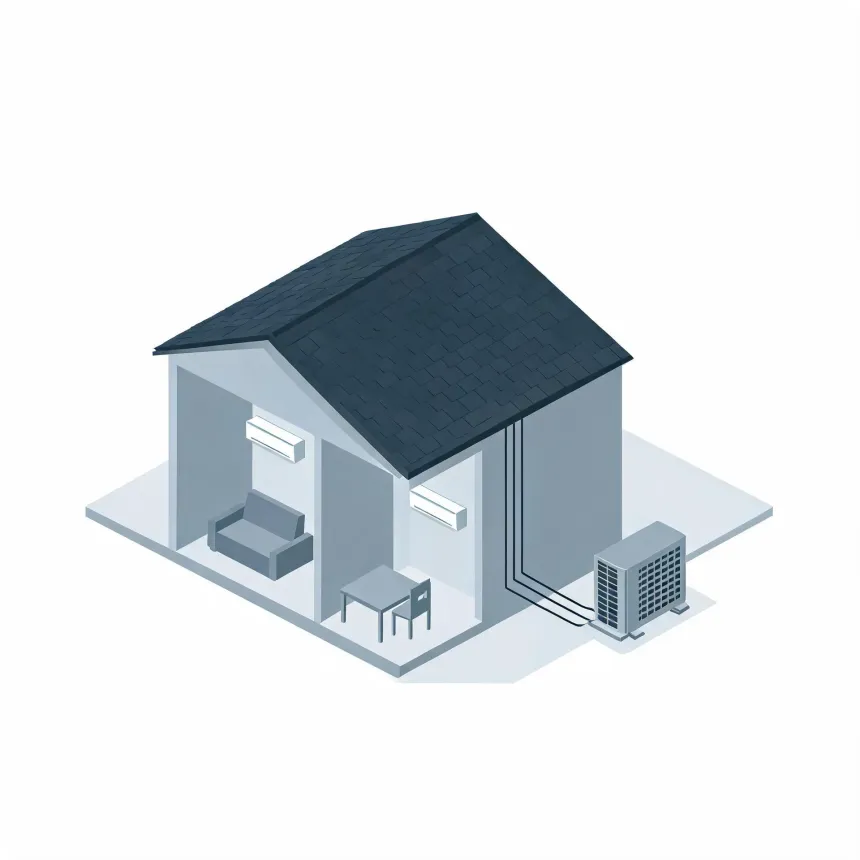
- A single outdoor unit can run one indoor head or several, depending on the system. A single-zone system covers one room or one open area. A multi-zone system ties several indoor heads to the same outdoor unit, with each head set to its own room and its own temperature. How many rooms one outdoor unit can carry depends on the size of the equipment and the size of the rooms, so a contractor needs to look at the house before that number is final.
- Can a mini split heat a whole house?
- It can, if enough zones are installed to reach every room. A multi-zone mini split puts one indoor head in each room or area, all run off the same outdoor unit, so the whole house gets covered rather than just the room the indoor unit sits in. Homes here need heat from October through April, seven months a year, so the system has to be sized for that much run time, not just a mild stretch of weather. Getting the sizing right for a whole house is a job for a contractor who can measure the space room by room.