Ductwork doing its job
This is what you want under the house. The runs are intact, the joints are tight, and the furnace pushes air straight through the metal to your rooms. Nothing leaks into the basement along the way.
Leaky ductwork usually shows up as rooms that never feel quite right. One bedroom stays warm in January while the rest of the house is comfortable, or a room upstairs lags behind in July no matter how long the AC runs. You might notice your system running longer than it used to, or dust settling faster than it should near vents, registers, or the attic hatch. Sometimes you can feel it directly: a draft near a duct joint, or warm air leaking into the attic when you put a hand near the ductwork up there. A duct system that leaks makes your furnace and AC work harder to hit the same temperature, since conditioned air is escaping into the attic or crawlspace instead of reaching the room it was meant for. With electric heat common in Warren County homes, that extra runtime shows up on the bill even with cheap power, because the unit still has to run longer to make up for what it's losing along the way.




Ductwork fails at the joints first. The sections themselves rarely crack, but the seams holding them together loosen over time, and once that happens your system is pulling in air it was never supposed to touch. In an attic in July that means hot air mixing into cool. In a crawlspace in January it means cold air cutting into warm. Either way, your furnace or AC ends up running longer to make up the difference, and that shows up on the bill before you ever see the duct itself. Some signs are things you notice without looking for them: a vent with more dust around it than the others, a faint whistle near a seam, a room that just won't hold the temperature the rest of the house holds. Others take a little more effort, like running a hand along a duct connection to feel for air moving where it shouldn't be. None of this requires opening up walls or ceilings. Most of it is the kind of thing you'd catch simply by paying attention to the rooms you're already standing in.


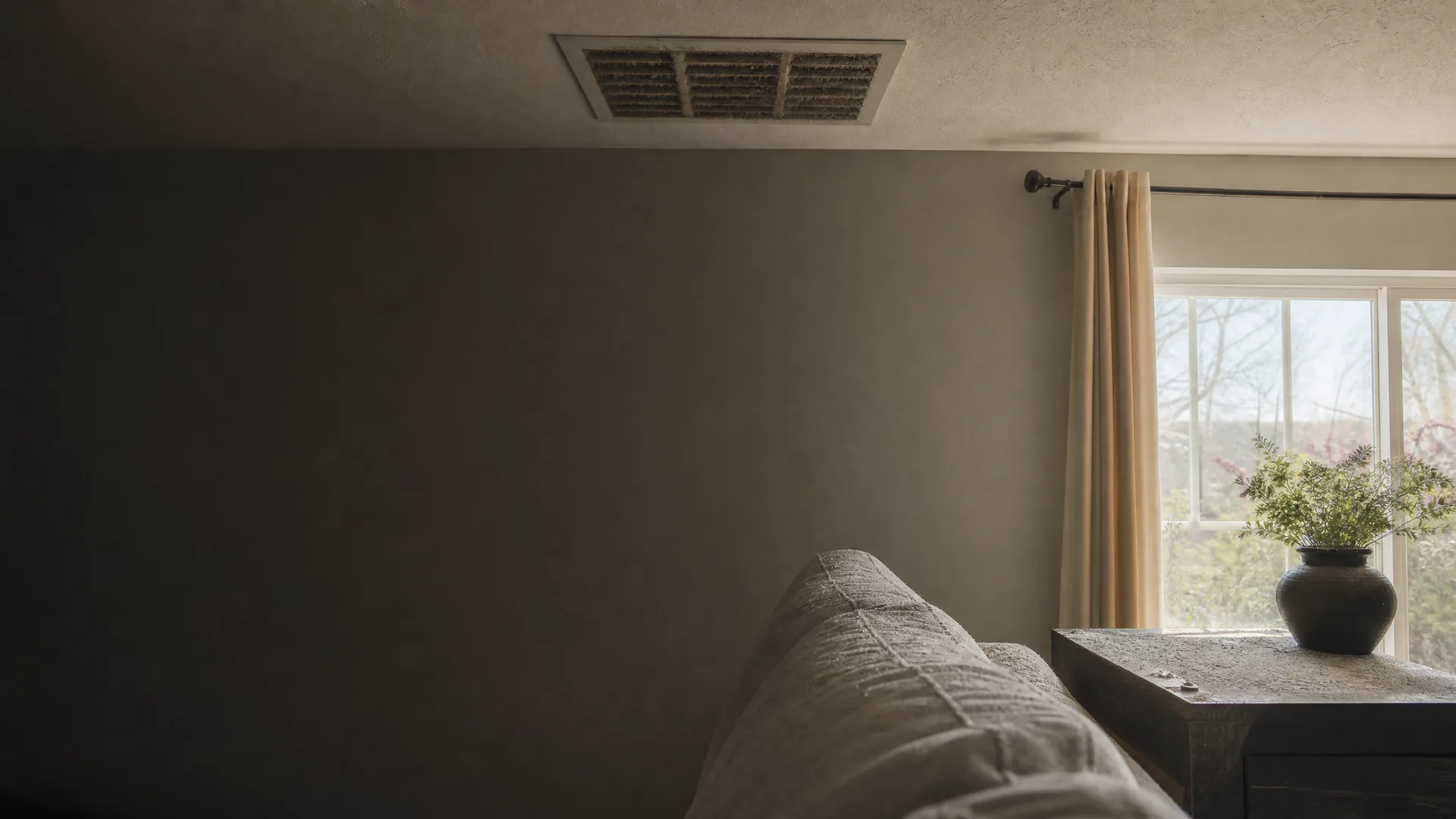
It's a Saturday afternoon in April, warm enough that the AC in your Bowling Green house has kicked on for the first time this year. You're running the vacuum when you stop under the ceiling vent in the living room. The grille has a gray ring of dust around it, thicker than you'd expect, and when you look down, the end table and the top of the couch cushion nearest the vent have a fine film on them too. You wipe it off and it's back within a day or two. The air coming out feels right, but something about how much dust is settling right there doesn't sit well with you.
Check the electric bill against last year's for the same month. If it's climbed and nothing else changed, the ductwork is a reasonable place to look. Warren County runs electric heat through a cold winter and AC through a long sticky summer, so a system working harder to make up for lost air shows up fast on the meter. You might also notice the thermostat set where it's always been, but the house takes longer to catch up after you've had the door open or come back from being out. None of this means a bigger problem is coming, but it does mean conditioned air is paying to heat or cool a space it never reaches, like an attic or a crawlspace, instead of your living room.

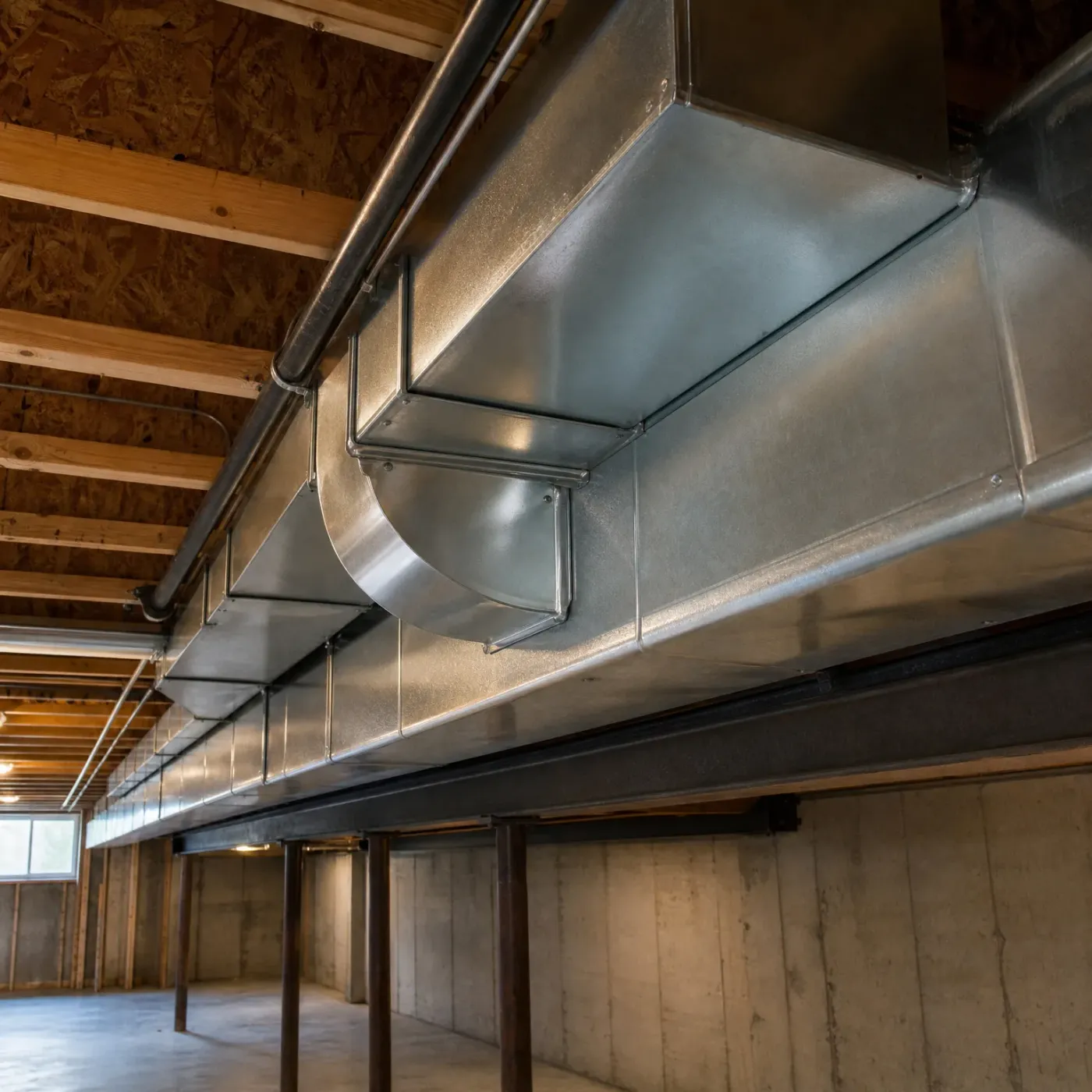
This is what you want under the house. The runs are intact, the joints are tight, and the furnace pushes air straight through the metal to your rooms. Nothing leaks into the basement along the way.

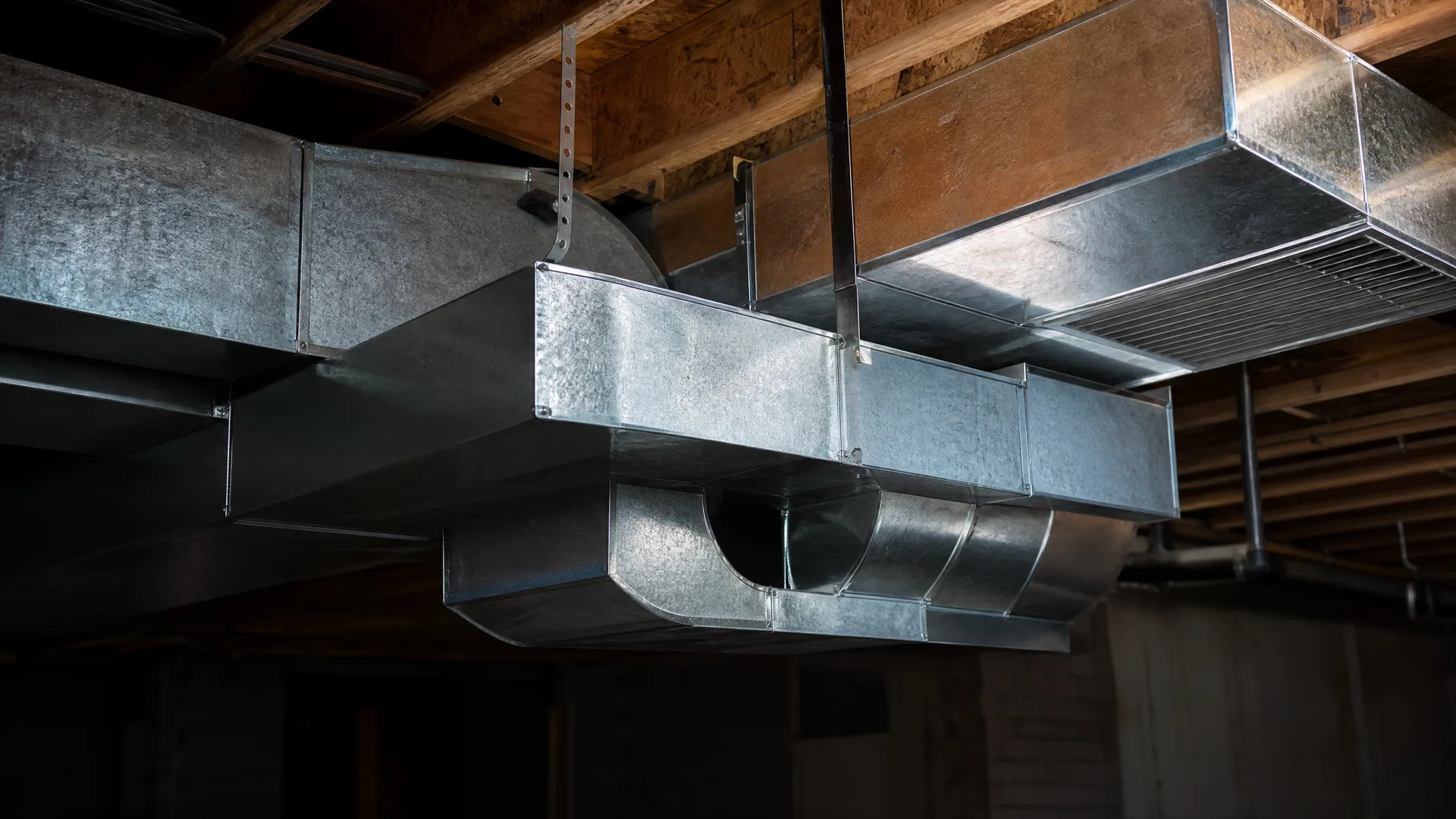
Here the ducts are feeding the space between the joists instead of your rooms. Conditioned air slips out before it reaches a vent, and that water staining on the foundation wall points to moisture problems that often ride along with it.
You've checked the vents in both rooms and they're both blowing, so it doesn't make sense that one side of your Bowling Green house is comfortable and the other isn't. The AC or furnace is running, the air is coming out, and yet the gap doesn't close no matter how long you wait. That usually points to something happening between the unit and the room, not at the vent itself.
Air moves through your ducts under pressure, pushed from the furnace or air handler toward every room at once. If a joint has come loose somewhere along the path to one particular room, that's where the air goes first, out through the gap, before it ever reaches the vent. The room at the far end of that damaged run gets whatever is left over, which on a hot July afternoon or a cold morning in January isn't enough to keep up. Rooms closer to the unit, or fed by ductwork that's still tight, get full pressure and stay comfortable. The room that struggles isn't getting less air because the system can't keep up. It's getting less because the duct feeding it is losing air along the way.


Air leaves your furnace or AC pushed by the blower fan.
It travels through the main trunk line toward each room.
At a loose joint, some of that air escapes into the attic or crawlspace.
Less air reaches the vent than the system actually produced.


Skip calling around for someone who cleans ducts.
One request and the search for a pro is handled.
It costs nothing to send, and you don't have to hire anyone.

A duct losing air in the crawlspace or attic means your furnace and AC are working to heat and cool space nobody lives in. You pay for that air. It never reaches a vent, so the thermostat reads the house as still not warm enough or still not cool enough, and the system keeps running to catch up. That's wear on a blower motor and a compressor that wouldn't happen if the air went where it was supposed to.
There's a comfort cost too, and a health one if the crawlspace or attic air pulled into the system carries dust or moisture into your ducts. You don't have to figure out on your own whether what you're seeing points to a leak worth sealing or just an old house settling. Send in what you've noticed and skip the part where you call around Bowling Green getting quotes, explaining the same symptoms three times, and sorting through estimates that don't agree with each other.

At 12.48 cents per kilowatt-hour, every bit of conditioned air that escapes through a loose joint still shows up on your bill. A duct system losing air to the crawlspace or attic makes your furnace or AC run longer to reach the same temperature, and in Warren County that extra runtime adds up fast since most homes here heat with electricity.
EIA-861 2025
Duct leaks don't make noise, so you won't hear one open up under the floor. The first clue is almost always the one you already noticed: a room that won't hold temperature no matter what the thermostat says.
By the time a room feels wrong, air has been leaking into the crawlspace or attic for a while. Cleaning the ductwork is the step that lets a contractor actually see where it's escaping.
Half the homes here were built by 1993
Half the homes in Warren County were built in 1993 or earlier, so half the ductwork out there has been through three decades of settling and temperature swings.
Heat runs October through April
Heat runs October through April here, about seven months. That's seven months a year for a loose joint to leak warm air into the crawlspace.
Cooling runs May through September
Cooling runs May through September. Five months of AC pushing air through the same ducts, and any gap loses you cooled air the whole time.
ACS 2020-2024 · NOAA nClimDiv 1991-2020
A room that runs hot in July or cold in January, dust collecting around a vent, an electric bill that's climbed without a reason: none of these prove a leak on its own. A dusty vent could just mean it's time to change the filter. A hot bedroom could be a closed register down the hall. But when a room that's never been comfortable sits next to a bill that keeps going up, the ductwork is where to look, because that's the pattern a loose joint or a crushed run actually makes in a house.
What it won't do is get better by waiting. Houses settle, joints shift, and a small gap tends to open further rather than seal itself back up. The only way to know for certain is to have someone get into the attic or the crawlspace and look at the actual trunk lines and joints, because the thermostat and the vents can only tell you something's wrong, not where.
That's the part that takes the most effort for a homeowner to arrange on their own: finding someone in Warren County who does this, explaining the same symptoms over the phone to two or three contractors, then sitting with quotes that don't quite match up. Sending the form once moves that search off your plate. From there, the comparing and the callbacks aren't something you have to manage yourself.
It's off your list after this