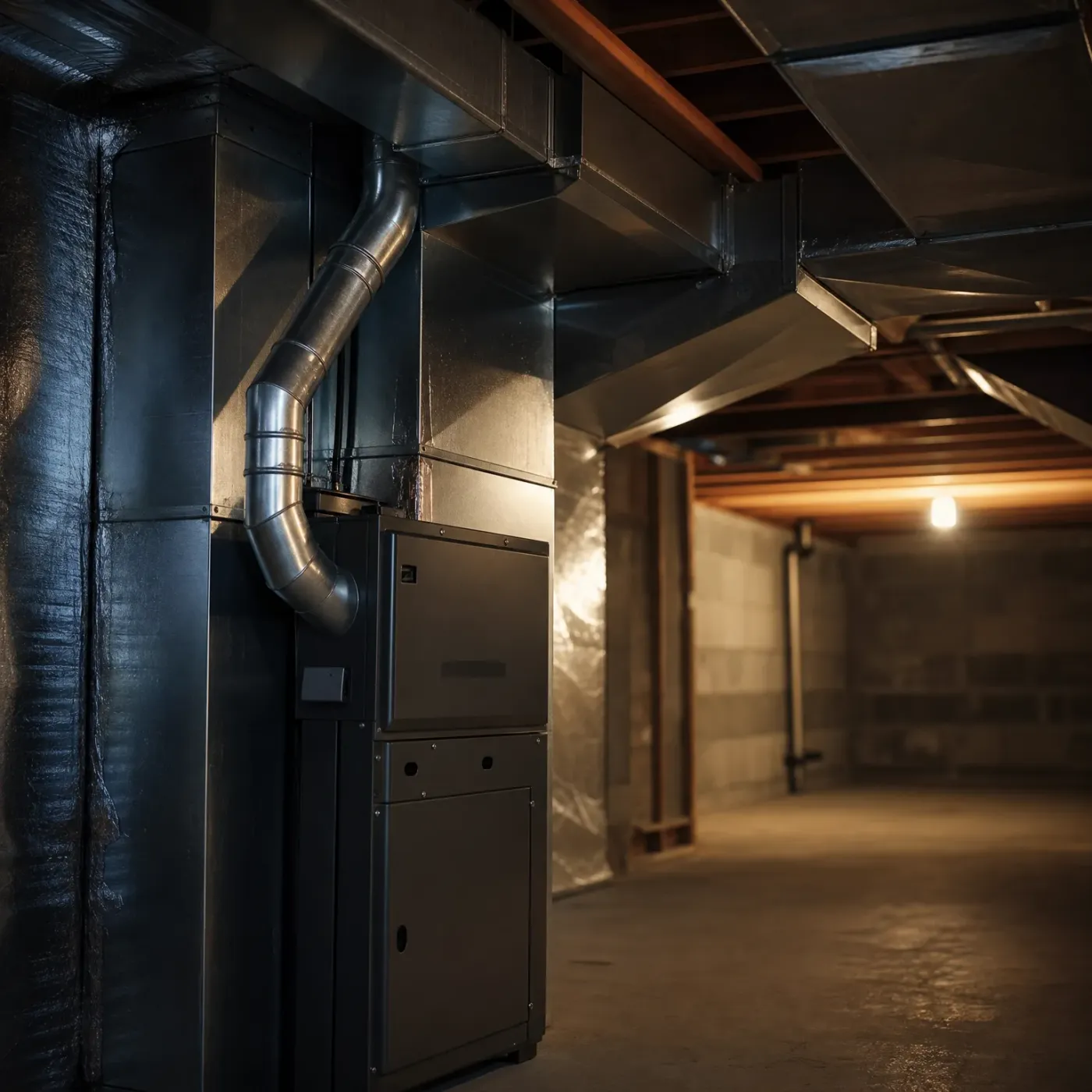
Basement interior with a furnace unit, insulated rectangular ductwork and a flexible metal pipe along the ceiling, with a bare lightbulb and concrete block walls in the background.

Find a duct system cleaning pro in Warren County

Mold in air ducts in Bowling Green, KY

Mold in ductwork means something is keeping the inside of your ducts damp, and with Bowling Green summers staying muggy for months, that moisture has plenty of time to work. This page covers what causes it, what it means for your air, and what cleaning actually involves. A local contractor who deals with duct systems in this kind of climate can take a look at yours and tell you what's going on.

Get matched

Mold growing in your air ducts means moisture is sitting somewhere in the system, usually around the evaporator coil or a section of ductwork that stays cold enough to sweat. That moisture comes from the air conditioner itself, condensation that should drain away but instead collects on a surface the dust in your ducts can feed on. In Warren County, where the air stays humid for months at a stretch, the AC runs long enough each summer for that moisture to become a steady condition instead of a one-time event. Once mold takes hold, your system pushes air across it every time the AC or furnace runs, and that air carries spores and a musty smell into the rooms you live in. A smell near the vents, dust that looks dark or sticky, or a mustiness that gets stronger when the AC kicks on are the usual signs. The ducts have to be cleaned and the moisture source fixed, or the mold comes back.

Unfinished basement with concrete walls and floor, a steel beam on posts, and exposed wooden joists with sheet-metal ductwork and piping overhead.

Dry ductwork, no place for mold to start

This is what a duct system looks like when the moisture is going where it should. The metal stays dry to the touch. Nothing drips onto the joists above or pools on the concrete below. Air moves through the ducts instead of condensation sitting in them.

Unfinished basement with bare concrete walls and floor, and galvanized sheet-metal HVAC ducts, pipes and wiring running along the wood-joist ceiling.

Dampness that gives mold a place to grow

Here the trouble isn't the ductwork alone. Moisture in the basement air, from the ground, the plumbing, or a condensation line that isn't draining right, settles on cold duct surfaces. Mold needs that dampness to start, and a basement like this gives it plenty of places to hold.

Why does mold keep coming back in your ducts here?

  • Half the homes here were built by 1993

    Half the homes in Warren County were built in 1993 or earlier, old enough that the ductwork or insulation has had time to shift or wear thin.

  • Heat runs October through April

    Cooling runs May through September here, five months of the coil sweating and that moisture sitting in the ducts if nothing carries it away.

  • Cooling runs May through September

    Heat takes over October through April, seven months where the system runs dry, so mold that took hold in summer gets sealed in rather than cleared out.

ACS 2020-2024 · NOAA nClimDiv 1991-2020

A gray-haired man in a dark coat with snow on the shoulders and collar stands smiling in a dimly lit entryway with a paneled front door, lamps, and a framed picture in an adjoining room.
A gray-haired, bearded man in a dark winter coat with snow on the shoulders stands in a doorway of a home interior with a lit lamp, framed pictures, a potted plant and a staircase behind him, and an evergreen wreath at the left edge.
An older man with gray hair and a beard, wearing a snow-dusted dark coat and knit scarf, stands smiling in a dimly lit house entry with a lit lamp, mirror, and a living room with snow visible through the window behind him.
A smiling gray-haired man in a dark wool coat with snow flecks stands in a dimly lit home entryway, with a lit table lamp, potted plant, framed pictures and a living room visible behind him.
  1. Condensation collects on the evaporator coil as warm air passes over it

  2. Water drips into the drain pan and should flow out through the condensate line

  3. A clogged drain or a sagging duct section lets that water sit instead

  4. Mold spores already in the air settle on the wet metal and insulation

Clean the Ducts or Stop the Water

Clean the ducts

  • A contractor can clear mold already growing on duct walls and clean up what's settled in the drain pan and nearby runs.
  • If the moisture source gets fixed at the same time, cleaning the ducts actually solves the problem instead of covering it up.
  • Cleaning alone, without fixing the clog or the sagging duct section, means the mold comes back within a season.
  • A thorough cleaning reaches sections a homeowner can't get to, including runs behind walls or above the evaporator coil.
  • Cleaning costs less upfront than any repair work, but it buys you nothing if the coil or the drain line is still the problem.

Fix the moisture source

  • Clearing a clogged condensate line or resealing a duct joint stops the water from collecting in the first place.
  • This work addresses why the ducts got wet, not just the mold that grew once they did.
  • A sagging duct section usually needs support added underneath, not just a reseal, or it will dip and collect water again.
  • Fixing the source without cleaning the ducts leaves existing mold and spores sitting in the system even after the leak stops.
  • Doing both the repair and the cleaning in the same visit means the contractor isn't guessing at what caused the mold.
A dim room corner with a dark grey sofa and cushion, a wooden side table holding a ceramic vase and a small potted plant, a linen curtain beside a bright window, and a wall vent near the ceiling.

It is a Tuesday afternoon in April, warm enough that you finally opened the windows in the living room. The light coming through them lands right on the ceiling vent, and you notice the grille has gone gray around the slats, with dust built up thick enough to see from the couch. The side table underneath has a fine layer on it too, the kind you only half-notice until the sun hits it this way. You run a finger along the grille and it comes away dark. The air conditioner hasn't even kicked on yet for the year, but whatever's been sitting in that line all winter is already working its way down into the room.

The right pro for this job

Your duct cleaning request goes to one local pro.

It costs nothing to send, and you don't have to hire anyone.

What a musty smell is telling you

If the air coming out of your vents smells musty, especially right when the AC kicks on, that smell is mold releasing spores into the airstream. It usually fades after the system has run a few minutes, because the air moving past the growth thins it out before it reaches your nose. That does not mean it is gone. The growth is still there every time the coil sweats, and the smell will come back the next time the system sits idle and starts up again. A smell that only shows up at startup points at the coil or the drain pan near it rather than the ductwork further out.

What a coating of dust is hiding

Mold needs something to feed on, and dust along the inside of a duct gives it that. A thin coating is normal over a season of running. A thick coating, especially one that looks dark or matted rather than gray and loose, usually means moisture has been sitting against it long enough for growth to take hold underneath. Pulling a vent cover and looking a few inches into the duct with a flashlight will show whether what is there is dry buildup or something damp. A contractor checking the same spot will also check the drain pan and the coil above it, since dust alone at the register rarely explains growth that far into the run.

Power here costs 12.48 cents per kilowatt-hour

Power here runs 12.48 cents a kilowatt-hour, cheap enough that most homes lean on electric heat and air without much thought to the bill. That's worth knowing because it means the fix for duct mold is rarely cost that's stopping someone. A contractor can clean the ducts and fix the moisture problem without the electric rate being the reason it waited this long.

EIA-861 2025

Galvanized sheet metal HVAC ductwork and insulated flexible ducts running along a wooden-joist ceiling beside a plain light-colored wall.

A duct system that stays sealed

If your ductwork is sealed tight and insulated where it runs through the crawlspace or attic, the air inside stays close to room temperature. There's no cold metal surface for humid air to hit and no sweating on the outside of the ducts. A contractor who seals a seam or adds insulation where it's thin is removing the one condition mold needs to take hold, not just cleaning up after it already has.

Galvanized sheet metal HVAC ductwork running along a wood-joist ceiling beside a plain light-colored wall, with white pipes nearby.

A duct system with a gap somewhere

A gap in insulation, a seam that's come apart, or a return pulling in air from a crawlspace lets humid air meet a cold duct surface and bead up. That water sits on metal or soaks into insulation and gives mold a place to grow that a filter never touches. Cleaning the ducts helps, but if the gap stays open, the same spot will be wet again the next time the air conditioner runs long.

A woman stands in the open front doorway of a single-story house with a covered porch, stone column bases and a dormer window, facing a man in a dark cap and gray polo shirt seen from behind in the foreground.

Mold in your ducts has a cause, and it can be fixed

Mold in a duct system is moisture that found somewhere to sit, long enough for spores already in the air to take hold. Fix the moisture, clear what's already growing, and the ducts stay clean. That's true whether it's a slow drain line, a sagging section, or insulation that's worn thin enough to let the metal sweat.

Finding which one it is in your house takes someone who's looked at enough duct systems around Warren County to know where they usually fail. A local contractor who works on this equipment every season can tell you what's actually going on in your attic or crawlspace, not just what's possible in general. You'll be matched with one contractor, not a handful, and that contractor will reach out to look at your situation directly.

A living room corner with a beige upholstered armchair holding navy and striped cushions, a small round wooden side table with a carved bowl and a potted green plant, a framed landscape picture on a pale wall, built-in shelving, and a curtained window.
A woman wrapped in a thick gray fleece blanket sits in an armchair with an open book on her lap, beside a lit lamp and a window covered in frost patterns at night.
A woman in a grey knit sweater leans back with closed eyes in an armchair beside a window, with a ceramic mug on a round wooden side table and a yellow-leaved tree outside.

Ductwork Cleaning

Matched to your ductwork job

Your request goes to one pro, not a list of companies.

A black-framed smartphone standing upright against a plain light gray background, its screen filled with solid green.
Duct and vent cleaningDucts or ventsWarren County, KY
Step 1 of 2

What ZIP code is the job in?