



How often to clean a dryer vent in Covington, KY

A stainless steel square wall vent with a curved hood and a hinged flap damper, shown straight on against a plain gray background.
Find my pro

Clean your dryer vent once a year. If you run loads daily, or your vent line is long or has several bends to reach outside, check it twice a year instead, since lint has more surface to catch on before it reaches the outlet. A clogged vent makes the dryer run longer to dry the same load, and that extra heat has nowhere to go but back into the drum and the duct. Over time that strain wears on the heating element or the motor, and a fully blocked vent is a house fire risk, which is the main reason this matters more than the extra minutes on a drying cycle. If towels take longer to dry than they used to, or the outside vent flap barely moves when the dryer runs, the line is likely already restricted. Once a year, on schedule, is the simple rule for most households in Covington.

What does your household mean for your dryer vent?

  • 2.52 people per household on average

    A household here runs 2.52 people's worth of laundry on average. More loads mean more lint moving through the vent each week.

  • Half the homes here were built by 1974

    Half the homes in Kenton County were built in 1974 or earlier. A vent line that old may have been patched or rerouted since, so check how yours is actually laid out.

  • Power here costs 13.57 cents per kilowatt-hour

    Electricity here runs 13.57 cents per kilowatt-hour. A dryer forcing air through a clogged vent uses more of it to finish the same load.

ACS 2020-2024 · EIA-861 2025

A once-a-year household

Say two or three people live in the house and the dryer runs a few loads a week. The vent line runs fairly straight to an outside wall, maybe one bend in it. Lint builds up slowly in a run like that, and once a year is enough to keep it clear. You'll still notice signs between cleanings. Towels take longer to dry than they used to, or the outside of the dryer feels warmer than normal. Those are worth checking even on an annual schedule, but they're the exception, not the rule, when the vent run is short and the laundry load is average.

A twice-a-year household

Now say the laundry runs daily, or the dryer vents through a long duct with a couple of turns before it reaches outside. Lint catches at every bend, and a longer run gives it more wall to cling to before it ever gets out of the house. In that case a year between cleanings is too long. Checking it in spring and again in fall catches buildup before it packs tight enough to slow the airflow. A longer, busier vent line isn't a flaw in the house. It just means the schedule that works for a neighbor with a shorter run won't be enough here.

An older man with gray hair and a beard stands in a doorway of a home, wearing a dark coat dusted with snow, with a lit fireplace and lamp visible in the blurred room behind him.
A bearded older man in a dark snow-dusted coat and scarf stands just inside a home's front door, with a lamp-lit room and snowy window visible behind him.
An older man with gray hair and a beard wearing a dark snow-dusted coat stands in a home entryway, with a lamp-lit living room and a wooden staircase behind him.
An older man with gray hair, a dark coat and scarf dusted with snow stands in a warmly lit entryway with an open wooden door, a table lamp, framed pictures, and a plant in a vase.

What a clogged vent costs you

Lint narrows the path the air has to take out of the house. The dryer senses that resistance and runs hotter and longer to get clothes dry, so a load that should take forty minutes stretches past an hour. You'll notice the top of the dryer feels warm, or the laundry room picks up a heat you didn't used to feel. The outside vent hood is the way to check without opening anything up. Run a load, go outside, and look at it. A strong, steady flow of air pushes the hood flap open. A weak flap, or one that barely moves, means lint is sitting somewhere in the line.


Why the bends matter more than the length

Lint doesn't fall out of moving air, it needs something to catch on. A straight run gives it nothing to hold to, so even a long straight line stays fairly clear. A bend slows the air down right at the turn, and that's where lint settles first. Two or three bends between the dryer and the outside wall is normal for most houses, but each one is a spot to check. If your line has to turn more than that to clear a wall or reach the outside, lint has more places to start building before it ever reaches the hood.

A white plastic dryer vent hood mounted on beige horizontal vinyl siding, with lint clogging its lower opening and a concrete foundation below.
Before you get your dryer vent cleaning
A white louvered dryer vent hood mounted with four screws on beige horizontal lap siding above a gray stucco foundation and concrete walkway.
After you get your dryer vent cleaning

A local pro for your dryer vent cleaning

After you send the request, you're done searching.

You're not committing to anything by asking.

A metal hooded exterior vent cover with louvered underside mounted on light gray horizontal lap siding, next to a plain pale wall at an outside corner.

What you'll notice first

The top of the dryer gets hot to the touch partway through a load. Clothes come out warm but not fully dry, so you run the cycle again. The laundry room picks up a warm, slightly burnt smell that wasn't there before. Check the outside vent hood while the dryer runs. If the flap barely moves or you feel only a weak puff of air against your hand, the line is restricting airflow somewhere between the dryer and the outside wall.

A white hooded dryer vent cover screwed to beige horizontal lap siding on an exterior wall corner, with a blank wall surface at left.

What it puts at risk

Lint is the fuel. A restricted vent holds more of it inside the line and around the drum housing, where heat builds with nowhere to go. That heat is what starts dryer fires, and most of them trace back to a vent that was never cleaned. It also shortens the life of the dryer itself, since the motor and heating element work harder on every load to push air through a line that's partly blocked.

Is Your Vent Due for Cleaning

Signs it's clean

  • A load of towels dries in under an hour on the normal setting, same as it always has.
  • The outside vent hood flap opens all the way when the dryer runs and swings shut when it stops.
  • You can hold your hand near the outside vent and feel a steady, strong flow of warm air.
  • The top panel of the dryer stays cool or just slightly warm through a full cycle.
  • Little to no lint shows up around the outside vent hood or on the ground beneath it.

Signs it needs it

  • Clothes come out hot but still damp, and you're running a second cycle to finish them.
  • The laundry room smells warm, almost like something is scorching, partway through a load.
  • The outside vent hood barely moves, or you feel little to no air coming out of it.
  • The top or front of the dryer is hot to the touch by the middle of a cycle.
  • Lint collects around the outside vent opening even though you clean the lint trap every load.
  • A drying cycle that used to take forty minutes now runs well past an hour.
A white hooded dryer vent with a louvered grille screwed to beige horizontal lap siding above a lighter foundation wall.

The vent hood opens and closes like it should

Air pushes the flap open wide when the dryer runs. Lint isn't catching on the edges or building up around the screen. Set your hand near the opening and you'll feel a steady, warm push of air coming out.

A wall-mounted plastic dryer vent hood on light-colored horizontal vinyl siding, clogged with lint and debris hanging from its opening, above a gray painted foundation.

The vent hood is choked with lint

This is what a line that hasn't been cleaned looks like from outside. Lint has packed into the grille until there's barely a gap left for air to pass. Some of what's built up there isn't lint at all, it's nesting material from something that found an easy way in.

A woman wrapped in a dark knitted blanket sits in an armchair with an open book in her lap, beside a lit table lamp and a frosted window.
An older woman in a cream knit sweater smiles while looking off-camera in a warmly lit kitchen, with a round loaf of bread on a wooden board in the foreground and a dark window behind her.

2.52 people per household on average

At 2.52 people, most houses here run a load or two a day rather than back to back. That keeps lint buildup moderate, so a yearly cleaning matches what your vent actually sees. A bigger household running the dryer constantly would wear toward the twice-a-year side faster.

ACS 2020-2024

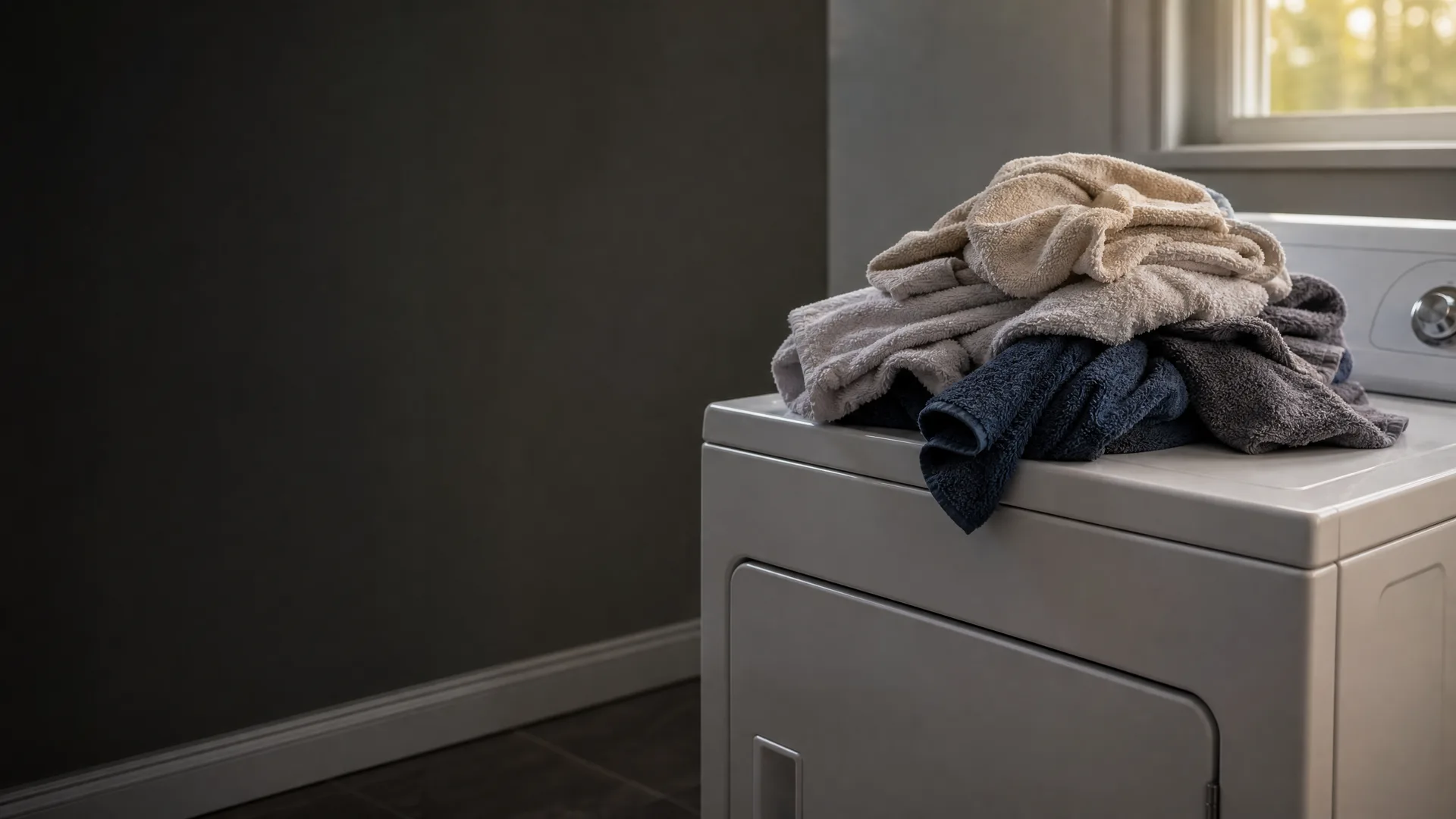
A pile of folded and rumpled towels in beige, gray, and navy sits on top of a white dryer in a room with a dark wall and a bright window.

It's almost nine on a Tuesday and you're still in the laundry room. The towels have been through twice now and the top of the dryer is warm under your hand. You open the door and they're not done, still damp at the seams, so you pull the lint trap, find it clear, and start a third cycle anyway. The room smells faintly warm, almost scorched, the way it hasn't before. Outside, the Kenton County air has already cooled off for the evening, but in here it's close and a little stuffy. You fold what's dry enough to pass and leave the rest heaped on the lid, telling yourself you'll deal with it after one more cycle.

A woman stands in the open front doorway of a single-story house with a dark hipped roof and light siding, while a man in a navy jacket and cap is seen from behind in the foreground on the paved walkway.

Once a year, twice if your household runs it hard

That's the answer. Once a year for most houses in Covington and around Kenton County, twice a year if the dryer runs daily or the vent line is long and bent getting to the outside wall. The flap outside tells you how you're doing between cleanings. Open wide when the dryer runs, warm air pushing out steady, towels dry in under an hour. That's a vent doing its job.

If yours doesn't look like that, or you're not sure when it was last done, a local contractor can check the line and clean it properly, including the parts of the run you can't reach from either end. Share a few details about your house and your dryer and you'll be matched with someone who services homes in your area. From there it's their job to reach out and sort out the rest, not yours.

Interior corner of a living room with a sheer-curtained window, a light wood console table holding a vase of greenery and a shallow bowl, a woven basket on the lower shelf, and a blurred upholstered sofa and dark wood table in the foreground.
A lit flagstone walkway bordered by low path lights and shrubs leads to the covered front entry of a light-colored clapboard house with a dark door, flanking potted plants, and a glowing porch light at dusk.

Dryer Vent Cleaning

Get the right pro for your dryer vent

Duct and vent cleaningKenton County, KY
Step 1 of 3

What kind of equipment?

  • A ceramic vase holding dried flowers and a shallow stoneware bowl sit on a wooden table beside a bright window, with a paneled wall and framed picture behind.
    • Get matched with someone who does this kind of work in Kenton County.
    • Say what's going on with your dryer vent, and a pro who works on them reaches out.
  • A stoneware jug holding dried pink and green hydrangea blooms sits on a polished wooden sill beside a dark lidded box and a metal candlestick, in front of a multi-pane wood window with blurred greenery outside.
    • Send the request and finding a pro stops being your problem.
    • After this form, you can stop searching for a dryer vent pro.
  • A white window sill holding a ceramic vase with olive branches and a shallow wooden bowl, with blurred green foliage and a neighboring roof visible through the window and a woven basket below.
    • Fill out one short form instead of calling around.
    • Explain the job once and skip repeating it on every call.
  • A green fern in a light gray ceramic pot with a matching saucer sits on a wooden table beside a glass-based lamp, next to a curtained window.
    • The pro who gets in touch is licensed in Kentucky and works in Kenton County.
    • A licensed pro who works in Kenton County gets your request.